
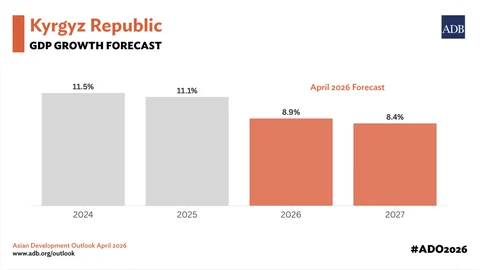



Bishkek, April 10, 2026 /Kabar/. Economic growth in the Kyrgyz Republic is projected to moderate from an estimated 11.1% in 2025, but remain strong at 8.9% in 2026 and 8.4% in 2027, according to the Asian Development Outlook (ADO) April 2026, the Asian Development Bank’s (ADB) flagship economic publication.
Growth is expected to ease as construction and trade normalize, while domestic demand remains the main driver, supported by resilient remittance inflows and sustained investment under the National Development Program 2030.
“The Kyrgyz Republic is well positioned to sustain strong growth over the medium term, underpinned by continued public investment and resilient domestic demand,” said ADB Country Director for the Kyrgyz Republic Zheng Wu. “To translate this momentum into lasting gains in productivity and living standards, it is essential to advance private sector-led development and deepen structural reforms that mobilize investment and strengthen the business environment. ADB remains committed to supporting these efforts to strengthen long-term growth and resilience.”
Inflation is projected to rise from 8.2% in 2025 to 10.3% in 2026, before moderating to 8.5% in 2027—driven by strong domestic demand, scheduled increases in electricity and heating tariffs, and exchange rate pass-through. Inflation is expected to remain above the central bank’s 5.0%–7.0% target range throughout the forecast period. The National Bank of the Kyrgyz Republic is likely to maintain a tight monetary stance to contain inflationary pressures, including continued foreign exchange interventions.
ADO April 2026 highlights the transition toward a more private sector-led growth and the strengthening of the foundations for private investment as a key policy priority for the Kyrgyz Republic. Despite strong growth in recent years, labor productivity gains have been limited and informality remains widespread, reflecting insufficient private investment in productive, job-creating sectors. Net foreign direct investment inflows have averaged 2% of GDP, while domestic credit to the private sector stands at 23% of GDP—well below regional averages. Addressing these constraints will require comprehensive and well-sequenced structural reforms.
ADB is a leading multilateral development bank supporting inclusive, resilient, and sustainable growth across Asia and the Pacific. Working with its members and partners to solve complex challenges together, ADB harnesses innovative financial tools and strategic partnerships to transform lives, build quality infrastructure, and safeguard our planet. Founded in 1966, ADB is owned by 69 members—50 from the region.