In the heart of Central Asia, the peaks of the Tian Shan Mountains cradle the Kyrgyz Republic, known as the "Switzerland of the East" for its breathtaking nature. Today, Bishkek is transcending its role as a pristine tourist destination to emerge as an ascending strategic player, transforming its geographical landlocked isolation into an opportunity for global connectivity.This transformation is evident in the strengthening of relations with the Gulf Cooperation Council (GCC) countries, within a multi-track diplomacy that balances geopolitical equilibrium with shared economic interests.
Zhaparov's Diplomacy: Opening Toward the Arab Depth
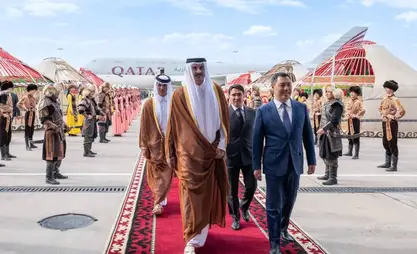
The era of President Sadyr Zhaparov represents a turning point in Kyrgyz foreign policy. Bishkek has adopted a strategy of "multiple paths," maintaining strong ties with Russia and China while opening wide doors toward the Gulf. This policy manifested through intensive visits up to early 2026, including attendance at Arab-Islamic summits in Riyadh (November 2024) and Jeddah, multiple visits to the UAE (2024–2025), and a historic visit to Bahrain (April 21–22, 2025)—the first-ever visit by a Kyrgyz president to Manama—at the invitation of King Hamad bin Isa Al Khalifa. These efforts yielded agreements in investment, development, and energy. The Saudi Fund for Development supported infrastructure projects, while Kyrgyzstan benefited from Bahrain's expertise in Islamic banking. In the UAE, visits culminated in the establishment of a joint investment company and major investments through Masdar in hydropower. In Qatar, prior visits paved the way for the Emir of Qatar's visit to Bishkek and funding for the largest mosque in Central Asia. In Bahrain, discussions covered health, infrastructure, an air services agreement, a sports memorandum, and a joint statement reinforcing cooperation within the C5+GCC framework.This dynamism reflects strategic awareness: the Gulf serves as a source of financing and expertise, helping diversify reliance away from the two neighboring powers and positioning Kyrgyzstan as an attractive "investment partner" in food security, tourism, and renewable energy.
Boosting the Economic Side: The Saudi-Kyrgyz Business Council
The inaugural meeting of the Saudi-Kyrgyz Business Council was held in Bishkek (August 2024), culminating on May 21, 2025, with the signing of the official agreement to establish the joint council, on the sidelines of the Saudi-Kyrgyz Business Forum. It was attended by Kyrgyz Economy Minister Bakyt Sydykov, Chairman of the Saudi Chambers Federation Hassan Al-Huwaizi, and more than 35 representatives from major Saudi companies, alongside over 100 investors.The council aims to explore opportunities in:Hydropower and renewable energy
Tourism and logistics
Agricultural exports and food security
Healthcare and pharmaceutical industries
Thereby enhancing the partnership and opening broader horizons for Gulf investments in Central Asia.Transport Revolution: Breaking the Geographical SiegeThe main challenge remains Kyrgyzstan's landlocked status. However, the China–Kyrgyzstan–Uzbekistan (CKU) railway project represents a qualitative leap. Estimated at $4.7 billion, with a $2.3 billion Chinese loan (35 years), construction began gradually in 2025 (progress in tunnels), with completion expected between 2028–2030. It will shorten shipping times to South Asia and the Gulf by hundreds of kilometers, making Kyrgyzstan an efficient gateway.
Shared Interests: Food Security and Green Energy
Interests converge in two sectors: Food security: Gulf countries seek to diversify supplies. Kyrgyzstan possesses agricultural potential (meat, honey, nuts, dried fruits), with notable export growth to Saudi Arabia and the UAE in 2024–2025, including new shipments such as horses.Green energy: Vast potential in hydropower and renewables. UAE's Masdar signed agreements in 2023 for multi-gigawatt projects, with progress on a 200 MW solar project (expected operation in 2026). Saudi and Emirati investments contributed to GDP growth exceeding 6%.
Cultural Diplomacy: Tourism as a Civilizational Bridge
The shared Islamic bond and common values strengthen the partnership. Visa exemptions and direct flights have increased the flow of Gulf tourists (from Saudi Arabia, UAE, Kuwait). Kyrgyzstan has become a preferred destination for families seeking peaceful nature. Total foreign visitors reached approximately 8.9 million in 2024–2025, supporting economic stability.
Future Prospects: Smart Geopolitical Balance
Zhaparov seeks a balance that combines traditional ties with Russia and China, and partnerships with the Gulf and Turkic states. This is evident in Kyrgyzstan's activity within C5+GCC (Jeddah summit 2023, Samarkand May 2025). Gulf investments in Central Asia have grown since 2022, with plans for more in 2026. Despite opportunities, challenges remain in managing debt, ensuring independence, accelerating projects, and regional competition. The partnership extends to food security, clean energy, and tourism, turning challenges into sustainable opportunities.In this way, Bishkek is drawing a civilizational and economic bridge linking the mountains of Central Asia to the shores of the Gulf, in a changing world.
By Abdulhamid Hamid Al-Kba
Writer and researcher on Central Asian and Azerbaijani affairs