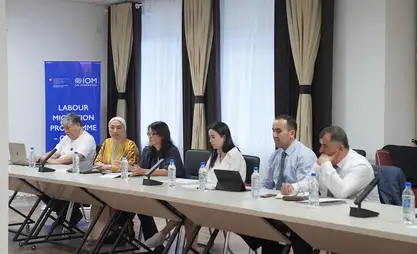
The International Organization for Migration (IOM) in Tajikistan has completed the first phase of the Labor Migration Program – Central Asia (LMP-CA), marking the milestone with a seminar held in Dushanbe on June 18 to assess achievements and identify priorities for the next stage, Asia-Plus reported.
According to press release issued by IOM in Tajikistan, the Seminar on Analysis and Validation of Results brought together representatives of government agencies, the private sector, civil society organizations, and program beneficiaries to review the outcomes of the initiative.
The event was held in an interactive discussion format. Participants worked with 10 stories collected through interviews, examining their accuracy and completeness. They discussed the accounts in small groups, identifying missing context, correcting factual inaccuracies, and ensuring the stories reflected actual experiences.
The stories highlighted the program’s work in four key areas: strengthening migration governance institutions; expanding labor migration opportunities through new employment corridors; protecting migrants’ rights during migration and upon return; and supporting people who migrated, returned home, or launched businesses in their communities.
The second part of the seminar focused on challenges and areas where progress had been limited.
Participants pointed to several persistent issues, including insufficient awareness among migrants about existing protection mechanisms, difficulties in sustaining institutional reforms without ongoing support, and the need for a more comprehensive approach to the reintegration of returning migrants.
Based on the discussion, participants identified several priorities for the program’s second phase.
One key recommendation was to strengthen the use of data in migration policymaking. Participants noted that migration policies should be based on reliable and up-to-date statistics, which remain limited in many areas.
Another priority is ensuring that existing migration tools and mechanisms are used more effectively. While a number of support systems have already been developed, many migrants are either unaware of them or lack confidence in using them.
Participants also stressed the importance of closer cooperation among government agencies, international organizations, employers, civil society groups, and migrants themselves.
“Systemic changes in the field of migration are possible if work is carried out simultaneously at several levels — with institutions, people, and data,” said Ms. Gulnora Kamolova, Head of the Labor Mobility and Inclusion Department. “The first phase laid a solid foundation. Now it is important not to lose the achievements and continue moving forward.”
Following the seminar, IOM will revise the stories based on participants’ feedback and coordinate their publication with partners. The final collection is intended to serve as a documentary record of the program’s first phase, highlighting the changes achieved and their impact on people’s lives.
The Labor Migration Program – Central Asia is supported by the Swiss Agency for Development and Cooperation (SDC) and the International Organization for Migration.
The multi-year regional initiative aims to improve labor mobility governance, promote safe migration pathways, and protect the rights of migrant workers across Kazakhstan, Kyrgyzstan, Tajikistan, and Uzbekistan.
Its core areas of work include supporting evidence-based migration policies, diversifying labor migration destinations, expanding migrant support services, and facilitating the socio-economic reintegration of returning migrants and their families.