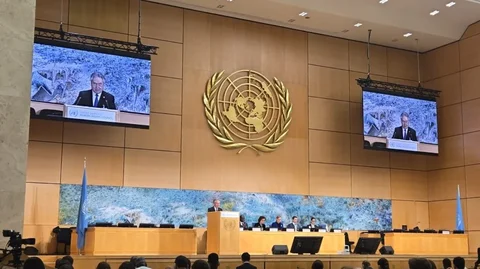
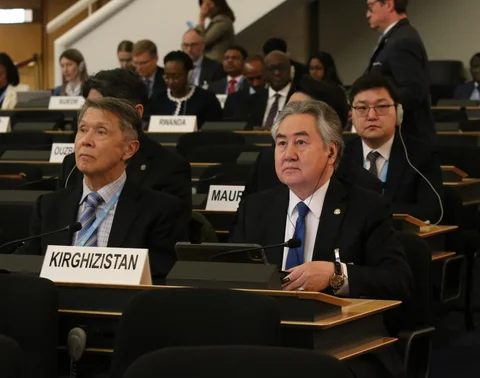
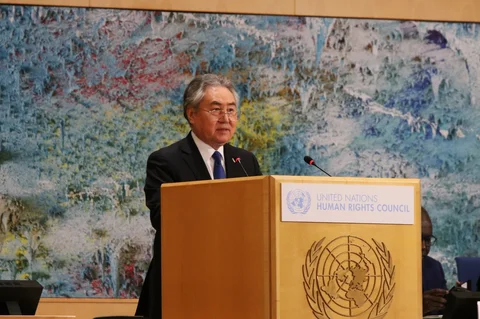


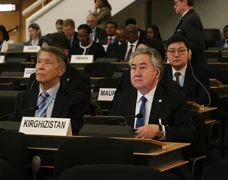
Bishkek, Feb 24, 2026 /Kabar/. Kyrgyz Foreign Minister Jeenbek Kulubaev participated in the High-Level Segment of the 61st session of the UN Human Rights Council in Geneva.
According to the Foreign Ministry's press service, the event was also attended by UN Secretary-General António Guterres, UN General Assembly President Annalena Baerbock, and UN High Commissioner for Human Rights Volker Turk.
In his speech, Minister Kulubaev summarized the Kyrgyz Republic's three-year membership in the Council and expressed concern about the crisis of trust in multilateral institutions and international law.
He called for the protection and strengthening of the existing international system, which is particularly important for small states.
The minister welcomed the ceasefire achieved in Gaza and emphasized that sustainable peace is impossible without the full participation of the Palestinian people in the peace process.
Regarding the situation in Afghanistan, he emphasized that its isolation only exacerbates humanitarian problems and negatively impacts the observance of fundamental human rights.
The foreign minister noted that Afghanistan should be viewed not only as a crisis zone, but also as a country with great human and economic potential.
In his speech, the minister also noted that in 2025, thanks to the political will of the leaders of Kyrgyzstan, Tajikistan, and Uzbekistan, the long-standing border dispute in the Fergana Valley was resolved. He emphasized that the peoples of the three countries have made a conscious choice in favor of security, trust, and dialogue as the foundation of sustainable development and regional stability.
Speaking about domestic policy, Jeenbek Kulubaev reaffirmed Kyrgyzstan's commitment to human rights as the foundation of state policy. He noted the country's unwavering commitment to the rule of law and reaffirmed its irrevocable abolition of the death penalty.
The minister also informed the international community about the 2025 parliamentary elections, which will be held with broad international observation and the use of digital technologies. Noting the 33 percent quota for women in parliament, he emphasized Kyrgyzstan's commitment to the principles of gender equality.