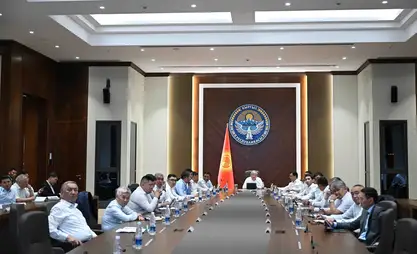

Bishkek, June 1, 2026. /Kabar/. During staff meeting of presidential administration, Adylbek Kasymaliev, Chairman of the Cabinet of Ministers summarized the results of two reforms under the 100-day "Government Accelerators" program.
The first reform was the simplification of goods identification procedures and the acceleration of the issuance of permits for customs clearance.
Previously, clearance processes involved a significant amount of manual work, the need for repeated interagency interactions, and lengthy document review periods. Data verification and analysis by government agencies took up to 14 business days, and in some cases, up to one month. In 2025, 16,314 permits were issued, including 2,280 licenses and 14,006 clarifications on export-controlled goods and the Unified List of the EAEU.
The reform included comprehensive optimization of business processes, updating the regulatory framework, modernizing application processing mechanisms, and integrating government agencies within a single-window system. As a result, participants in foreign economic activity now have the ability to submit applications electronically through a single digital interface without having to repeatedly contact various agencies.
One of the key elements of the modernization was the introduction of the ai.trade.kg, digital platform, which uses artificial intelligence technologies to analyze product characteristics and generate recommendations when reviewing specific categories of permits.
Thanks to the introduction of electronic data exchange, automation of procedures, and the use of electronic digital signatures, the timeframe for providing government services has been significantly reduced. The timeframe for issuing clarifications, identification, and expert opinions from government agencies has been reduced from 14 to 3 business days.
The measures being implemented facilitate the expedited customs clearance of goods, reduce the administrative burden on businesses, cut costs for participants in foreign economic activity, and increase the transparency of government procedures. All stages of application processing are accessible to applicants in real time through their personal account.
The second reform was the simplification of the medical examination process for pre-conscription age individuals upon initial military registration.
Previously, medical examinations were conducted at district military commissariats and were associated with a significant workload for medical specialists, large volume of paperwork, and a lack of efficient interdepartmental data exchange. This process required the involvement of medical workers away from their primary activities, which negatively impacted the work of healthcare organizations.
Within 100 days, digital medical examination model was developed and implemented using the Sanarip Clinic medical information system. This model allows for examinations, the issuance of reports, and the adoption of decisions by the military medical commission in an electronic format. Interdepartmental integration was also ensured, electronic exchange of medical reports was implemented, and a service for checking the commission's status was implemented through the Tunduk mobile app.
The pilot project was implemented at Chui Regional General Practice Center, replacing district military commissariats. During the pilot, 788 pre-conscription age individuals underwent digital medical examinations, with all reports processed and transmitted electronically through the Tunduk interagency collaboration system.
The project significantly reduced the workload of medical professionals, eliminated the need for paperwork, and ensured transparency and efficiency of procedures. Following successful testing, this model will be gradually scaled up throughout the Kyrgyz Republic. As a reminder, Adylbek Kasymaliev initiated these reforms on January 14, 2026, during staff meeting of presidential administration.