
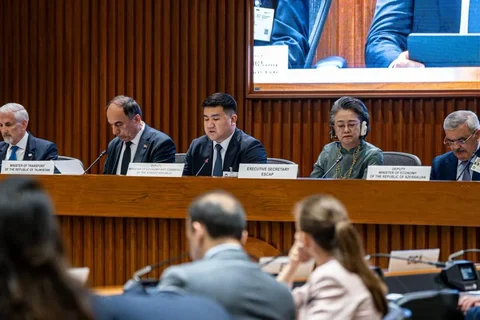



Bishkek, April 23, 2026 /Kabar/. On April 22, 2026, the SPECA ministerial meeting was held in Bangkok, Thailand, chaired by Kyrgyz Deputy Minister of Economy and Commerce Mederbek Tumanov. This was reported by the ministry's press service.
As a reminder, Kyrgyzstan assumed the chairmanship this year in Bangkok.
Mederbek Tumanov stated that the main priority of the Kyrgyz Republic's SPECA Chairmanship in 2026 is the development and promotion of transport and logistics connectivity in the Central Asian region.
As the deputy minister emphasized, to achieve this priority, Kyrgyzstan identifies the following key areas and objectives:
- Development of sustainable transport and infrastructure: the creation of a regional hub, the development of the Middle Corridor, and the construction of the China-Kyrgyzstan-Uzbekistan railway, which is seen as a key factor in strengthening transport connectivity and economic development for the entire region;
- Digitalization of transport corridors: the implementation of the SPECA Roadmap for the digitalization of multimodal data exchange within the Trans-Caspian Transport Corridor;
- Economic development through support for small and medium-sized businesses and the promotion of cross-border initiatives aimed at achieving the Sustainable Development Goals.
Kyrgyzstan also supports the efforts of participating countries to transition to the use of electronic freight data in accordance with UN standards, including UN/CEFACT standards, by 2027. In this regard, Kyrgyzstan expressed its willingness to serve as a pilot country for the implementation of these standards.
In his speech, Mederbek Tumanov focused on the simplification of trade procedures, the transition to cross-border paperless trade, the development of e-commerce, and active work within the Intergovernmental Agreement on Dry Ports to overcome logistical challenges. In this regard, the Kyrgyz Republic has joined the Framework Agreement on the Facilitation of Cross-Border Paperless Trade Procedures in the Asia-Pacific Region.
"We view these areas as key tools for overcoming logistical and infrastructure challenges and highly appreciate our country's re-election for the second term as Chair of the UNESCAP Paperless Trade Council," he noted.
He also expressed gratitude to the ESCAP Secretariat for its support in developing the Kyrgyz Republic's National Action Plan for the Transition to Paperless Trade. The plan is currently nearly complete, and its presentation is scheduled for the upcoming meeting of the Trade Facilitation Council in the Kyrgyz Republic.
Background:
The United Nations Special Programme for the Economies of Central Asia (SPECA) was established on March 26, 1998, based on the Tashkent Declaration. The Programme's main goal is to promote economic cooperation in the SPECA region and the integration of its member states into the global economy in the context of achieving the Sustainable Development Goals.
ESCAP (the United Nations Economic and Social Commission for Asia and the Pacific) is one of the five UN regional commissions, headquartered in Bangkok. It serves as the SPECA secretariat, assisting Central Asian countries in coordinating joint projects.