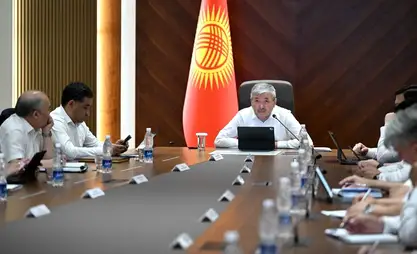

Bishkek, June 29, 2026. /Kabar/. At the latest staff meeting of the Presidential Administration Chairman of the Cabinet of Ministers Adylbek Kasymaliev officially launched the latest 100-day reforms. New initiatives are aimed at systematically reducing bureaucracy, completely eliminating paperwork, and converting the most in-demand government services to a modern, proactive digital format.
The first large-scale project is dedicated to radically simplifying the process of foreclosure removal by financial institutions. This procedure is currently one of the most common, accounting for almost half of all real estate transaction registrations. In the first five months of 2026 alone, more than 34,000 such procedures were completed. Despite this demand, citizens still face excessive bureaucracy: they must personally visit banks to obtain original documents, stand in line at government agencies, and wait several days for registration.
The chairman cited the lack of direct digital data exchange between financial institutions and the state real estate rights registry as the main reason for this situation.
To address this issue, online foreclosure removal registration service will be introduced in the "Tunduk" mobile app within 100 days. The new system will allow collateral providers to submit applications remotely, and banks to confirm the termination of obligations using a cloud-based electronic signature with automatic authority verification via the "E-Notary" system. Implementation of this reform will reduce the procedure time from two business days to five hours, completely eliminating the need for in-person visits to agencies.
The chairman identified the automation of pension and survivor's benefit extensions for students aged 16 to 23 as his second priority.
Currently, young people are required to annually confirm their education by submitting paper certificates to the Social Fund or the Ministry of Labor. Failure to submit documents on time results in payment suspensions, creating financial difficulties for vulnerable families and entailing additional costs for transportation and document printing. The main obstacle here was the fragmented databases of educational institutions and social agencies.
As part of the new challenge, full-fledged interdepartmental cooperation will be established through the "Tunduk" system. The Ministry of Science, Higher Education, and Innovation and the Ministry of Education will create a single, up-to-date student database, which will be integrated with the Social Fund and Ministry of Labor systems. Now, student status will be instantly verified online using a personal identification number, without the need for individual intervention. This will allow more than 18,000 students to renew their social benefits automatically within one to two minutes, eliminating the risk of document forgery and human error.
Summarizing the meeting, Adylbek Kasymaliev set a 100-day deadline for the implementation of both initiatives.
He emphasized that the state system must value citizens' time and serve their interests, ensuring maximum convenience and transparency. He instructed all responsible agencies and financial institutions to immediately begin work on these tasks.