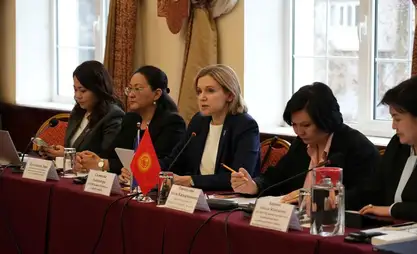
The Ministry of Natural Resources, Ecology and Technical Supervision of the Kyrgyz Republic (MNRETS) together with UNDP launched the preparation of the “Combined Second Biennial Transparency Report (BTR2) and Fifth National Communication (NC5).” The event took place on 10 March 2026 with the participation of representatives of government agencies, international institutions, the scientific community, and climate change experts.
As a Party to the United Nations Framework Convention on Climate Change (UNFCCC) and the Paris Agreement, the Kyrgyz Republic is fulfilling its commitments to ensure transparency and reporting under the Enhanced Transparency Framework (ETF). All Parties submit Biennial Transparency Reports and National Communications to ensure accurate, regular, and transparent reporting on greenhouse gas inventories, mitigation measures, adaptation actions, and support received. These processes are directly linked to the implementation of NDC3.0, ensuring alignment between national climate actions and international commitments while supporting measurable progress in adaptation and mitigation.
“Today’s launch of the preparation of BTR2 and the Fifth National Communication opens a new phase of this work. Our task is not only to ensure the timely and high-quality preparation of reporting, but also to use this process as a tool for further improving national climate policy, strengthening inter-agency cooperation, and enhancing the quality of data,” said Asel Raimkulova, Deputy Minister of MNRETS, at the opening of the seminar.
In 2025, the country successfully prepared its first Biennial Transparency Report (BTR1), strengthening national institutional mechanisms, inter-agency coordination, and technical capacity to track progress in mitigation and adaptation. Building on the achievements of BTR1, MNRETS has now begun preparing the combined BTR2/NC5, integrating data and analytical tools into a unified climate policy management system.
In her remarks, Alexandra Solovieva, UNDP Resident Representative, highlighted the role of the carbon market. “Around the world, it is becoming one of the instruments to accelerate the low-carbon transition, provided that it is built on transparency and quality. For Kyrgyzstan, it could become an opportunity to attract investments into modernization and energy efficiency, sustainable management of landscapes and forest ecosystems, and technologies that simultaneously reduce greenhouse gas emissions and create jobs. A strong national system for accounting, monitoring, and transparency is closely linked to the country’s future opportunities in the climate and investment landscape,” she said.
The objectives of the project include:
- Institutionalizing regular climate reporting cycles
- Deepening analytics and improving data visualization
- Integrating gender, regional, and socio-economic dimensions
- Strengthening the link between reporting and the implementation of climate policy and national priorities reflected in NDC3.0
- Using transparent data to mobilize climate finance and attract investment in low-carbon development.
The project is implemented by MNRETS of the Kyrgyz Republic with the support of UNDP, funding from the Global Environment Facility (GEF), and coordination by the United Nations Environment Programme (UNEP) to fulfill the country’s obligations under the Enhanced Transparency Framework (ETF) and IPCC requirements, while strengthening transparency, trust, and the effectiveness of national climate action.
The launch seminar also provided an opportunity to present the key results and lessons learned from BTR1, familiarize participants with the requirements and timeline for preparing BTR2/NC5, define the roles and responsibilities of government agencies and expert groups, strengthen coordination among ministries, partners, and technical experts, and develop a roadmap for timely and high-quality reporting.
All these actions will support the implementation of NDC3.0, national adaptation plans, and the low-carbon development strategy, strengthening the long-term resilience of the economy, ecosystems, and the quality of life of the population.