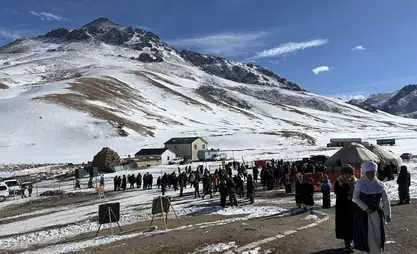
A view of the Naryn region of Kyrgyzstan during a winter cultural event with horses and yurts in the background.
A landlocked country in Central Asia, bordering Kazakhstan, China, Tajikistan and Uzbekistan is gradually becoming a more popular destination for international visitors. Although most tourists still come from neighbouring countries and Russia, Bishkek seems to be stepping up efforts to welcome tourists from the Arab world.
Over the years, Kyrgyzstan has actively strengthened political and economic ties with Arab nations, particularly in the Gulf, aiming to diversify its foreign policy and attract investment. Bishkek now seeks to extend this cooperation to the tourism sector as well.
For the former Soviet republic with a population of around seven million, Arab countries are among the top tourist markets, according to Erdenet Kasymov, Director of the Department of Tourism under the Ministry of Economy and Commerce of the Kyrgyz Republic. As he explains, to draw a large number of tourists from the Middle East and North Africa, the Central Asian country has begun actively investing in improving its infrastructure and making travel to the country easier.
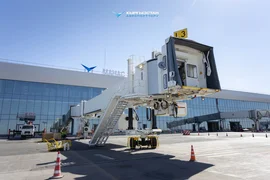
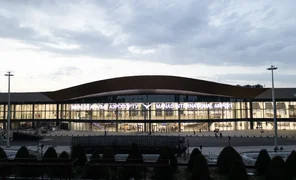
“There are already direct flights from Abu Dhabi, Dubai, Kuwait, Jeddah and Riyadh to Bishkek, and this year we plan to organise a roadshow for tour operators from six Arab countries, the United Arab Emirates, Saudi Arabia, Kuwait, Qatar, Oman and Bahrain,” Kasymov told The Arab Weekly, noting that attracting tourists from Arab countries is among Kyrgyzstan’s key priorities.
His department is particularly interested in bringing Arab visitors to the Naryn oblast, Kyrgyzstan’s most mountainous, least populated (around 312,000 people) and largest region by area. In this part of the country, travelers can explore hidden valleys, high mountain passes and alpine lakes that remain largely untouched by mass tourism. That, however, could change, as the authorities seem keen on drawing more international visitors.
According to Elmira Turganbayeva, Head of Kyrgyzstan’s President’s Office in the Naryn Region, whose economy is centred on herding animals such as sheep, horses and yaks, with wool and meat as the main products, a significant number of Israeli tourists is already visiting this scenic part of the country, drawn by its fresh air and clean water. Arab visitors could also enjoy the same natural beauty, as well as stay in yurts, go trekking, horseback riding and even take part in ski-touring adventures during the winter months.
Local authorities and private operators are increasingly investing in eco-lodges, cultural centres and guided tours that highlight the Naryn region’s, as well as Kyrgyzstan’s broader, rich nomadic heritage. Visitors can witness local festivals and enjoy culinary experiences featuring dishes made from locally -ourced ingredients, including horse and yak meat.
These initiatives aim not only to attract international visitors but also to ensure that tourism contributes positively to local communities. Sustainable tourism is also a key focus, with efforts to protect Kyrgyzstan’s fragile mountain environments.
Local tour operators report growing interest from travellers in the Gulf who are seeking authentic experiences in a relatively untapped destination, while the government sees this as an opportunity to position Kyrgyzstan as a “premium tourism destination,”where visitors can enjoy adventure, culture and nature while supporting local livelihoods.
A potential, though minor, concern is that the authorities might consider charging a fee for visiting Kyrgyzstan.
“We want to focus on high-net-worth individuals willing to pay an entrance fee upon arrival to Kyrgyzstan, $30 or $50, to enjoy a quality experience,” Edil Baisalov, Kyrgyzstan’s Deputy Prime Minister, told The Arab Weekly, emphasising that the price is “reasonable and will help preserve the country’s natural beauty and social well-being.”
Still, at this point, it remains unclear whether his proposal will be accepted. Kyrgyzstan has long held the status of “Central Asia’s only democracy,” which means it is entirely possible that Baisalov’s idea may not be implemented.
Even now, when critics accuse the government of growing authoritarian tendencies, democracy still prevails, at least in the field of tourism.On February 12, during the presentation of the updated master plan for the Almaty–Bishkek tourism corridor, where The Arab Weekly was the only foreign media outlet present, representatives of various Kyrgyzstani tourism associations openly criticised Kasymov and his team, accusing them of “just talking and doing nothing to advance tourism in the country.” He received the criticism graciously, asking them to share their proposals on how to improve tourism in the Central Asian state. Such a scene would be unimaginable in neighbouring nations, where public criticism of officials is rarely tolerated.
With officials willing to engage directly with industry representatives and consider new ideas, Kyrgyzstan is signalling that it wants to stand out in Central Asia not only for its natural beauty but also for its openness and adaptability. For visitors from the Arab world and beyond, the message is clear: Kyrgyzstan is ready to welcome them, offering unique experiences in its mountains, valleys, and cultural heartlands.
Written By Nikola Mikovic
Source: The Arab Weekly