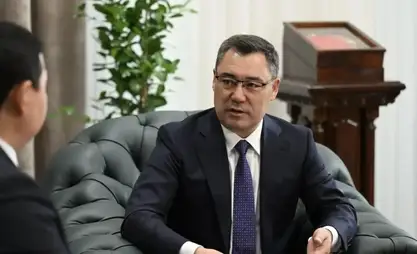
Kyrgyzstan has achieved a historic victory by securing a non-permanent seat on the UN Security Council with the support of 142 states. Kabar News Agency asked President Sadyr Zhaparov what diplomatic efforts were behind this success and how the resolution of border issues in Central Asia has affected the trust of the international community.
Hello, Sadyr Nurgozhoevich. Yesterday, Kyrgyzstan was elected as a non-permanent member of the United Nations Security Council, receiving the support of 142 out of 191 member states. Many are calling this a historic event. An earlier attempt to elect Kyrgyzstan was made in 2011, but at that time, the countries of the world supported Pakistan rather than Kyrgyzstan. What was our country's path to achieving this historic success, and when did the main work begin?
Frankly speaking, we began working with countries around the world well in advance—two years before the election.
It was thanks to this work that we achieved victory.
I would like to take this opportunity to once again express my deep gratitude to the leaders and diplomats of the countries that supported us.
What difficulties, competition, or doubts did you face during the election campaign? How did Kyrgyzstan overcome these obstacles?
Of course, any election presents certain challenges. Voting is conducted by secret ballot. A state may declare its support, yet ultimately cast its vote differently.
Nevertheless, our diplomats did an excellent job. There were some doubts at the initial stage. However, about five or six months before the vote, I was already confident that we would be elected.
In recent years, Kyrgyzstan has become a key initiator in resolving border issues with neighboring states, making a significant contribution to strengthening sustainable peace and mutual trust in Central Asia. To what extent did this factor influence Kyrgyzstan's election as a non-permanent member of the UN Security Council?
Of course, this factor played a very important role. The resolution of border issues that had remained unresolved for many years came as a surprise to many countries and to the United Nations.
At a time when territorial disputes, armed conflicts, humanitarian crises, and loss of life continue in various parts of the world, many expected unresolved issues in Central Asia to persist as well.
However, we were able to unite our efforts and resolve all outstanding issues through dialogue and negotiations. The international community witnessed this. Therefore, I can say that this factor played a significant role in our victory.
What priorities and initiatives does Kyrgyzstan intend to promote through its activities on the Security Council? What agenda does our country propose to the international community?
As early as February of this year, I was confident that Kyrgyzstan would be elected to the UN Security Council. Therefore, I instructed Foreign Minister Jeenbek Kulubaev and the Head of the Foreign Policy Department, Sagynbek Abdumutalip, to begin the necessary preparatory work.
"Kyrgyzstan will become a member of the UN Security Council. Therefore, when we attend the UN General Assembly in September, we should be prepared to propose substantive reforms to the UN Charter and its procedures, bringing them into line with today's realities and strengthening the authority and effectiveness of the United Nations. Begin considering possible amendments and proposals now," I told them.
Since then, all our diplomats have been working to carry out these instructions.
God willing, when we attend the United Nations meetings in September, we will present a number of serious proposals.
We need to strengthen the authority of the United Nations. Decisions adopted by the UN must be respected and implemented by all member states.
At present, the decisions of many UN bodies are often not fully implemented. In practice, Security Council resolutions tend to receive the greatest degree of compliance.
Therefore, we will submit proposals to amend the UN Charter.
UN decisions should be implemented in full. States should act in accordance with international law and the principles of the UN Charter rather than unilaterally.
If sanctions are to be imposed on any state, this issue should be considered within the framework of the United Nations, and such measures should be adopted through collective decision-making mechanisms.
It is important to address the current situation in which individual states may impose sanctions on other states on their own initiative.
These and many other proposals for reform will be presented.
Sadyr Nurgozhoevich, there is no doubt that the support of 142 countries reflects a high level of international trust in Kyrgyzstan. What new responsibilities does this trust place on the state in matters of human rights, freedom of speech, the rule of law, and the protection of citizens' rights?
Human rights are respected in our country and will continue to be respected. Freedom of speech exists and will continue to exist.
At the same time, we have one fundamental requirement: people must not spread slander or false information, make unfounded accusations against state institutions, incite ethnic hatred, promote regional divisions, or engage in other actions that violate the law.
For many years, freedom of speech was often interpreted as the freedom to spread rumors, speculation, and unverified claims. Such issues did not always receive adequate attention, and public discourse was frequently dominated by political rhetoric.
Today, however, a number of laws regulating these matters have been adopted. These laws are in force and are being applied in practice. Those who were accustomed to making loud statements and baseless accusations are gradually learning to operate within the framework of the law. Representatives of non-governmental organizations have likewise adapted to these legal requirements.
Before, there were attempts to promote ideas and activities that were not always consistent with the traditions and values of our society. Various marches and demonstrations were regularly held. Today, all public processes take place within the framework of the law, and we live according to the principles of the rule of law.
If there are shortcomings or mistakes on the part of the authorities, those who raise such issues on the basis of facts and evidence will always have the opportunity to be heard.
If there are cases of corruption or misuse of public funds, people should speak out regardless of who may be involved. Such citizens are helping both the state and society.
We will not show leniency toward those who harm the interests of the state and the people. Our citizens see and understand this.
Thank you.