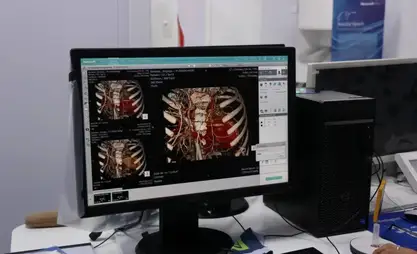
An artificial intelligence-powered, high-precision 512-slice computed tomography (CT) scanner has been installed and put into operation at State Central Third Hospital, Montsame reported.
Hospital Director Tumur-Ochir Ts. said the installation will allow Mongol citizens to receive advanced diagnostic services at home. “This is the first time such a high-capacity scanner has been installed in Mongolia. Previously, coronary artery examinations using a 64-slice CT scanner took two to three hours. With this new device, the same procedure can be completed in just seconds. It will also reduce the need for patients to travel abroad for diagnostic testing,” he said.
The new scanner can produce cardiac imaging in an average of 0.259 seconds and perform a full-body vascular examination in just five seconds. Its AI-based advanced algorithms reduce image distortion caused by patient movement and breathing, enabling clearer and more precise visualization of blood vessels and pathological changes.
According to Dr. Delgertsetseg D., a medical doctor and associate professor at the hospital’s Diagnostic Imaging Referral Center, processing cardiac CT images previously required about two hours but can now be completed within 10 minutes.
“The scan itself takes only two to seven seconds. While the previous equipment allowed us to examine an average of five patients per day, the new scanner will enable us to serve at least 20 patients daily, or more than 500 patients per month,” she said.
The hospital plans to provide examinations free of charge for inpatients, critically ill patients, and cases with unclear diagnoses.
The Neusoft NeuViz Epoch 512-Slice CT Scanner is among the highest-resolution diagnostic imaging technologies currently in use in developed markets, including the United States, European Union countries, Singapore, Malaysia, and Japan. The system costs approximately USD 2 million on the international market.
The introduction of advanced technology is expected to improve the accuracy and speed of diagnosing cardiovascular, neurological, pulmonary, and other diseases, while enhancing the quality and accessibility of healthcare services in Mongolia.