Bishkek, Sept. 8, 2026. /Kabar/. Scholars and experts from 23 countries called for a unified professional effort to preserve the diversity of nomadic cultural heritage, strengthen intercultural dialogue, and ensure the living continuity of traditions for future generations, the organizers said following the International Scientific and Practical Conference "Cultural Heritage of the World's Nomadic Peoples: Preservation, Study, and Development."
The conference was held on September 3–4 at the Chyngyz Aitmatov Cultural and Ethnographic Center "Rukh Ordo" in Cholpon-Ata as part of Section 3 of the International Scientific and Practical Conference "Nomadic Civilizations: Heritage, Paradigms, and Prospects" of the 6th World Nomad Games. The conference was organized by the Ministry of Higher Education, Science, and Innovation of the Kyrgyz Republic. The event was held in both offline and online formats in Kyrgyz, Russian, and English.
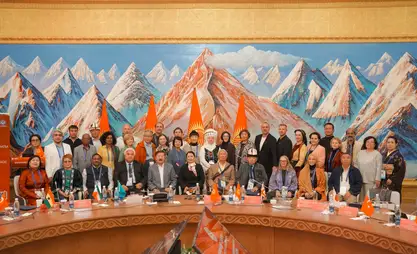
Representatives of the scientific and professional communities from various countries expressed interest in the conference. Over 100 applications were received. Forty-three scholars from 23 countries participated in the in-person work, and another 20 scholars presented their papers remotely.
Experts from Kyrgyzstan, Kazakhstan, Uzbekistan, Azerbaijan, Turkey, the United Kingdom, Slovenia, the United States, Canada, New Zealand, China, India, Pakistan, Japan, Mongolia, Greece, Italy, Hungary, Ghana, South Africa, Sri Lanka, Russia, France, and other countries participated in the scientific discussions.
The focus was on the preservation and development of traditional music, epic and storytelling art, crafts, musical instruments, oral traditions, and other forms of cultural heritage of nomadic peoples in the modern world.
One of the key topics was the "ustad-shakirt" system—a traditional form of knowledge and performance skill transmission from master to apprentice. Participants emphasized that cultural heritage cannot be preserved solely in museums, books, and archives. In their view, tradition remains alive when knowledge, skills, and mastery are directly transmitted to future generations through education, practice, performance, and creativity.
As part of the conference, scholars who are also representatives of traditional music held master classes for guests and participants. In particular, Japanese professor of traditional culture and performer Miho Yamaji led a master class on the koto, a traditional Japanese 13-string instrument.
Chinese representatives Wang Jianxin and Li Fengyun introduced participants to traditional musical instruments, including the ancient guqin zither, the xiao and dizi bamboo flutes, and the xun ocarina. The Chinese masters performed pieces from the classical repertoire.
Indian participant Manikat Rachana held a master class on traditional dance during the conference.
The scholars paid special attention to modern technology. Discussions included the creation of digital archives and databases, audio and video recording of traditional art, and the use of modern research methods and artificial intelligence.
Participants also noted the need to combine the use of new technologies with a respectful attitude toward the cultural context, as well as respect for the copyrights and collective rights and interests of tradition bearers.
International cooperation was another area of focus. Participants proposed expanding joint research and scientific expeditions, academic and educational exchanges, programs for young scientists and performers, international summer schools and master classes, as well as joint projects between universities, conservatories, research centers, archives, and cultural institutions.
Following the work of Section 3, the participants' research papers were further disseminated. Fifteen papers were included in the international scientific collection "Nomadic Civilizations: Heritage, Paradigms, and Prospects" published by the Ministry of Higher Education, Science, and Innovation of the Kyrgyz Republic. Another 64 scientific articles were published in a special issue of the Bulletin of the Arabaev Kyrgyz State University and the International Eurasian University.
Following the conference, a resolution was adopted outlining the main areas for further joint work between the international scientific and cultural communities.
These included the development of an international scientific platform for the study of traditional culture, the creation of digital archives and databases, support for outstanding traditional art practitioners, the development of a master-student system, the training of young researchers and educators, the use of modern technologies for the study and documentation of cultural heritage, the expansion of international scientific and educational exchange, and the development of cultural diplomacy.
Participants also advocated for the development of international inter-institutional projects capable of uniting the scientific potential of universities, conservatories, academic and research centers, archives, and cultural institutions from different countries.
The work of the section became part of the scientific program of the International Festival of Traditional Music.