Uzbekistan used the platform of Eco Expo Central Asia 2026 to deepen cooperation with leading international organizations and environmental institutions, as senior officials held a series of high-level meetings focused on biodiversity conservation, climate resilience, green innovation and sustainable development, Trend reports, citing the Uzbek National Committee on Ecology and Climate Change.
During the exhibition, Aziz Abdukhakimov, Presidential Adviser on Environmental Issues and Chairman of the National Committee on Ecology and Climate Change, met with representatives of global conservation, development and scientific organizations to discuss new avenues for collaboration.
One of the key meetings was held with Grethel Aguilar, Director General of the International Union for Conservation of Nature (IUCN). Discussions focused on biodiversity conservation, nature-based solutions, protected area management and the expansion of ecotourism initiatives.
The two sides also reviewed preparations for Uzbekistan’s updated National Biodiversity Strategy and Action Plan (NBSAP), the creation of a Regional Red List for Central Asia, and the development of transboundary protected areas across the region. Uzbek officials proposed strengthening cooperation with the International Union For Conservation of Nature (IUCN) regional office in Tashkent and jointly preparing projects under the upcoming Global Environment Facility (GEF-9) funding cycle.
Education and research were also high on the agenda. Officials discussed expanding the role of Green University as a regional center for environmental education and scientific cooperation, including partnerships with the Union For Conservation of Nature (IUCN) Academy of Environmental Law and the adoption of international academic practices.
Abdukhakimov also met with Fatou Haidara, Deputy to the Director General and Managing Director of the Directorate of Global Partnerships and External Relations at the United Nations Industrial Development Organization (UNIDO).
The discussions focused on green industrialization, clean technologies and industrial modernization. Abdukhakimov emphasized that environmental policy has become a central priority of Uzbekistan’s development strategy, noting that the recent transformation of the Ministry of Ecology into the National Committee on Ecology and Climate Change reflects a broader institutional commitment to sustainable development.
During the talks, Uzbek officials presented major national initiatives in afforestation, biodiversity conservation, waste management, air-quality improvement and environmental education. Particular attention was given to cooperation with UNIDO on developing regulatory frameworks for Best Available Technologies (BAT), promoting climate innovation and supporting startups through the Global Cleantech Innovation Programme (GCIP).
The parties also explored opportunities for implementing the “Climate Technology Innovation for Climate Resilience in Uzbekistan” project, which aims to strengthen climate analytics, early-warning systems and adaptation financing.
Another notable meeting took place with Dr. Ian Miller, Director of Science and Innovation at the National Geographic Society.
The discussions centered on raising the international profile of Uzbekistan’s and Central Asia’s natural heritage, expanding scientific research partnerships and promoting environmental education and documentary storytelling. Uzbek officials highlighted internationally recognized natural sites, including the UNESCO World Heritage-listed Western Tien Shan and Cold Winter Deserts of Turan, as well as wetlands protected under the Ramsar Convention.
Abdukhakimov proposed joint scientific expeditions to the Aral Sea region, mountain ecosystems and desert landscapes, along with collaborative documentary films, photography projects and digital content aimed at increasing global awareness of Central Asia’s unique environmental assets.
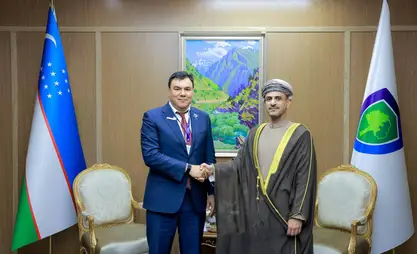
The Uzbek delegation also held talks with Abdullah bin Ali Al-Amri, President of Oman’s Environment Authority.
The two sides discussed practical cooperation in combating desertification, improving water-resource management, enhancing waste-management systems and protecting biodiversity. Uzbekistan proposed launching joint research initiatives on drought-resistant vegetation and sand stabilization technologies through the Regional Research Center for Combating Desertification and Developing Desert Economies at Green University.
In addition, officials explored opportunities for exchanging expertise in protected-area management, developing environmental education programs and establishing academic exchange initiatives between universities in Uzbekistan and Oman.
The series of meetings highlighted Uzbekistan’s growing role as a regional hub for environmental diplomacy and international cooperation, as the country seeks to advance sustainable development, green economic transformation and climate action across Central Asia.