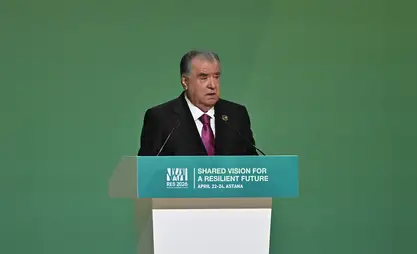
On April 22, leaders of Central Asian countries gathered in Kazakhstan’s Astana city for the Regional Ecological Summit, where President of Tajikistan Emomali Rahmon outlined the country’s key priorities in the fields of climate policy, water resources, and the "green" economy.
The Tajik leader’s speech came against the backdrop of intensifying climate risks in the region - ranging from water scarcity to ecosystem degradation and an increasing frequency of dust storms. These factors are increasingly viewed not only as environmental challenges but also as economic ones, directly affecting growth sustainability and social stability.
A central element of Tajikistan’s position is the water agenda. According to Dushanbe’s estimates, up to 60% of Central Asia’s water resources are formed on Tajikistan’s territory, making the country a key component of the regional hydrological system. In this context, particular emphasis was placed on the role of mountain ecosystems and the accelerating melting of glaciers, which could disrupt the water balance and increase the risk of natural disasters.
The promotion of the international water agenda remains one of Tajikistan’s main diplomatic priorities. The speech reaffirmed the country’s commitment to the Dushanbe Water Process, as well as to the implementation of initiatives under the International Decade for Action “Water for Sustainable Development". Additional emphasis was placed on strengthening the scientific base, in particular through the creation of a regional center for glacier and cryosphere monitoring under the auspices of international organizations.
At the same time, Dushanbe is strengthening the economic dimension of its climate policy. Priorities include expanding the use of renewable energy sources, improving energy efficiency, and developing a low-carbon economy. In this context, hydropower is considered a strategic sector capable of meeting domestic demand while also providing export potential.
Special attention was given to financial instruments. The authorities announced plans to introduce “green” financing mechanisms, including the issuance of green bonds, aimed at facilitating integration into global climate finance markets. It was also proposed to consider the gradual formation of a regional carbon market — an initiative that could reshape investment flows in Central Asia.
The environmental agenda is further complemented by biodiversity conservation and climate adaptation measures. The country is implementing long-term programs on the protection of rare species and afforestation through 2040. These measures are presented as part of a broader sustainable development strategy, where environmental, economic, and social policies are closely interconnected.
Emomali Rahmon also noted that Tajikistan is actively implementing state programs and projects aimed at preserving unique and rare species of mountain fauna.
"These and other efforts are aimed at protecting natural habitats and ensuring a responsible attitude toward nature," the head of state stated.
On the sidelines of the summit, the importance of strengthening institutional regional cooperation was also emphasized - from aligning positions on the international stage to reinforcing specialized structures, including centers for waste and water resource management.
Given the announced initiatives, the further development of the regional environmental agenda may follow several scenarios. In one case, Central Asian countries could enhance coordination in the water-energy sector and attract additional investment through international financial institutions and climate funds. An alternative scenario assumes partial implementation of initiatives amid continuing disagreements over water distribution and the pace of transition to a green economy. A third scenario involves accelerated institutionalization of cooperation, including the creation of regional carbon markets and digital resource management systems, which could increase transparency and reduce project costs. A more fragmented path is also possible, where individual countries pursue national strategies without deep regional integration.
Thus, the Astana summit not only outlined Tajikistan’s current priorities but also highlighted a broader trajectory for transforming the environmental agenda of Central Asia - from a set of separate initiatives toward a more interconnected regional development model.
Tags: