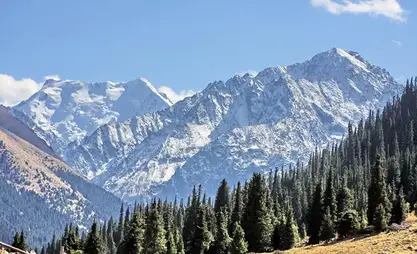
Bishkek, Nov. 18, 2025. /Kabar/. Kyrgyzstan, a mountainous country, continues to bring its initiatives to the international arena in response to current global challenges and is working to put them into practice. Ahead of International Mountain Day, the Ministry of Foreign Affairs shared with Kabar News Agency the significance of mountain ecosystems for the country.
International Mountain Day and its importance for Kyrgyzstan
Every year on December 11, the international community marks International Mountain Day. In 1998, the UN General Assembly proclaimed 2002 the International Year of Mountains. Later that same year, also at the initiative of Kyrgyzstan, the General Assembly established International Mountain Day to raise global awareness of the importance of sustainable mountain development.
Mountains are among the planet’s richest yet most fragile ecosystems. According to the UN, they cover nearly 27 percent of the Earth’s surface and are home to about 15 percent of the global population. Half of all biodiversity hotspots are located in mountain regions, serving as vital refuges for countless unique plant and animal species.
Mountains also function as the world’s “water towers,” providing 60–80 percent of the freshwater used for domestic needs, agriculture, and industry. The well-being of roughly half the world’s population depends on the water, food, and energy resources supplied by mountain systems. At the same time, mountain areas are becoming increasingly attractive destinations for recreation and eco-tourism.
Despite their importance, the world’s mountain regions face growing threats from climate change, land degradation, natural disasters, and the overuse of natural resources. Mountain populations are among the most vulnerable: they experience the highest levels of hunger and poverty. Rising temperatures and melting glaciers increase disaster risks in downstream valleys. According to UN data, one in three people living in mountainous areas of developing countries faces food insecurity.
These pressures force many mountain residents to migrate. The outflow of population to urban areas undermines the preservation of cultural identity and agrobiological diversity within mountain communities. Economically, mountain regions struggle with high transportation and production costs, difficult terrain, and harsh climatic conditions. Combined, these challenges negatively affect local socioeconomic development and hinder progress toward the Sustainable Development Goals.
As a predominantly mountainous country, Kyrgyzstan recognizes its responsibility in ensuring the well-being of mountain communities and promoting the sustainable development of mountain regions.
The Ministry of Foreign Affairs noted that Kyrgyzstan's foreign policy places particular emphasis on promoting the issues of mountain countries in the international arena. The ministry also emphasized that it is actively working within the UN and other international forums to draw attention to the problems of mountain countries.
Kyrgyzstan's activities to protect and preserve mountain ecosystems
To achieve sustainable economic, social, demographic, cultural, and natural development in mountain regions, the joint efforts of the international community are necessary.
Of particular note is the Bishkek Global Mountain Summit held in 2002, where the problems and development paths of mountain countries were discussed. The event resulted in the Bishkek Mountain Platform, a document that laid the foundation for cooperation on mountain region development. Mountain regions were included on the agenda of the UN Rio+20 International Conference on Sustainable Development (2012), which recognized the importance of mountain ecosystem services and the role of mountain communities in natural resource management. Mountain issues are also included in the 2030 Sustainable Development Goals.
As part of mountain initiatives, the international conference "Global Dialogue on Mountains for Sustainable Development: Towards the Bishkek+25 Summit" was held in Bishkek on April 24–25, 2025. President Sadyr Zhaparov, high-ranking guests from more than 50 countries in Europe, Asia, America, Africa, and Australia, as well as representatives of 29 international organizations, participated in the conference. The Global Mountain Dialogue was an important step towards the Second Mountain Summit "Bishkek+25" and the consolidation of states and international partners to address common challenges facing mountain regions and draw global attention to these issues. The dialogue played a significant role in advancing the mountain agenda globally.
At the initiative of Kyrgyzstan, the Second Bishkek Global Mountain Summit "Bishkek+25" will be held in Bishkek in 2027, 25 years after the first summit. The Ministry of Foreign Affairs is actively working to invite international partners to the upcoming event.
Climate Change: Kyrgyzstan’s Initiatives
Climate change is one of the most serious challenges of our time and poses direct threats to the essential systems that sustain mountain countries.
Since the early 2000s, Kyrgyzstan has consistently drawn international attention to mountain-related issues and, in recent years, has advanced several major initiatives at the UN General Assembly. Among them is the resolution "Sustainable Development of Mountain Regions," co-sponsored by Kyrgyzstan and Italy. It was thanks to this resolution that the international community declared 2023–2027 a five-year period of action for mountain development.
Work is now underway to implement this agenda through a Five-Year Action Plan for Mountain Regions, which includes both a national Roadmap and an international Global Action Plan. These documents were presented by the Kyrgyz Ministry of Foreign Affairs at UN Headquarters in New York in 2023–2024. In addition, as previously reported, Kyrgyzstan initiated the holding of the Second Bishkek Global Mountain Summit in 2027, a decision reflected in the adopted resolution.
The Ministry of Foreign Affairs also highlighted that preserving wildlife, particularly endangered species, is a crucial element in combating climate change and protecting biodiversity.
“For example, last winter, at the initiative of Kyrgyzstan, the UN General Assembly unanimously adopted a resolution on the snow leopard on December 12, 2024. This year, on October 23, events dedicated to raising awareness about the importance of protecting this iconic mountain species will take place worldwide,” the ministry noted.