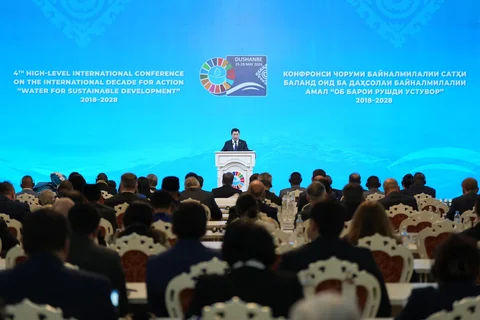
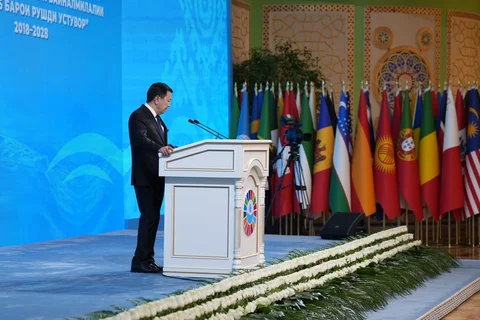

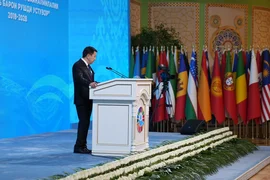


Bishkek, May 26, 2026. /Kabar/. Significant reduction of glaciers and decreased precipitation in Kyrgyzstan have already led to low water levels and could have serious socioeconomic and environmental consequences for the entire Central Asian region. Today, the problem of glacier melting is no longer a matter for one country; it is a challenge for all of Central Asia. Without glaciers, there will be no water in the rivers, and without water in the rivers, no life in the valleys. Erlist Akunbekov, Deputy Chairman of the Cabinet of Ministers and Minister of Water Resources, Agriculture, and Processing Industry of the Kyrgyz Republic, states during the working visit to Tajikistan at the official opening of the 4th High-Level International Conference on the International Decade for Action, "Water for Sustainable Development," 2018-2028.
In his speech, Erlist Akunbekov noted that the National Water Strategy of the Kyrgyz Republic until 2040 has been developed to ensure sustainable water resource management in the Kyrgyz Republic for the benefit of current and future generations, as well as to achieve the Sustainable Development Goals. Furthermore, taking into account the need to adapt to modern challenges, a new Water Code of Kyrgyzstan was adopted, providing for the introduction of modern mechanisms for regulating water relations, strengthening measures to protect water bodies, and developing integrated water resources management.
Erlist Akunbekov also recalled that, as Kyrgyz President Sadyr Zhaparov noted at the recent Regional Environmental Summit in Astana, the time has come to renew and implement a mutually beneficial economic compensation mechanism in the water and energy sectors. He stated that it is fair to implement compensation mechanisms that will allow upstream countries to effectively maintain water infrastructure for the benefit of all of Central Asia.
Furthermore, he emphasized that the rapid melting of glaciers, which serve as natural reservoirs and sources of freshwater not only in Central Asia but also in other regions of the world, is of particular concern in Kyrgyzstan. In this regard, he noted that extensive work is being carried out in the country as part of the Five Years of Action for Mountain Regions Development. He also invited participants to participate in the Second Global Mountain Summit "Bishkek+25," which will be held in Kyrgyzstan in 2027, to jointly discuss glacier protection and ensure a sustainable future for mountain regions.
Erlist Akunbekov focused his speech on the problem of the shallowing of Issyk-Kul lake, a pearl of Central Asia and a biosphere reserve of global significance. He noted that over the past decades, the lake's water level has dropped by almost 14 meters, and the number of rivers flowing into it has decreased from over 100 to 30. In this regard, he proposed that international donors and partners jointly develop and implement a comprehensive program to preserve and restore the lake.
In conclusion, Erlist Akunbekov expressed confidence that the results of the joint conference will be an important contribution to achieving a sustainable and equitable water future for all.