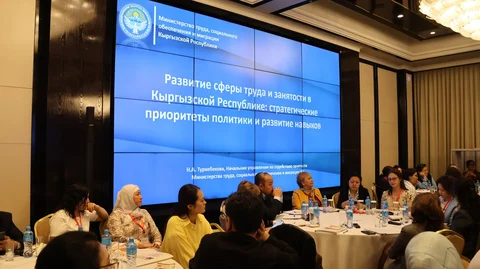
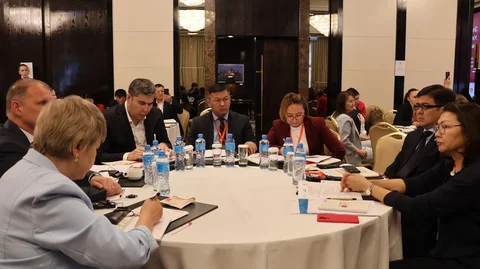
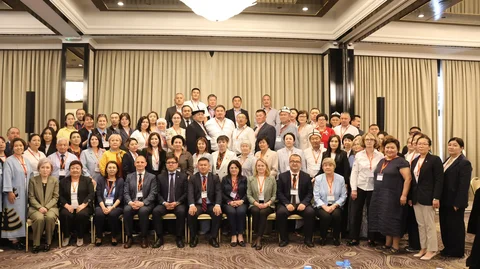

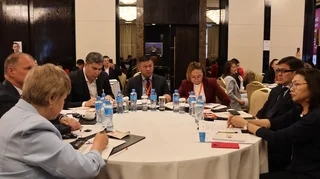
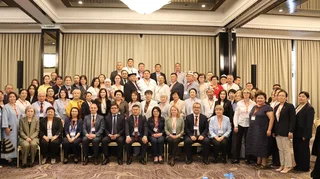
Bishkek, May 19, 2026 /Kabar/. The Second National Forum "Employment, Professional Skills, and the Future of Labor: Strengthening Public Employment Services and Non-Formal Education in the Kyrgyz Republic" is taking place in Bishkek.
According to the Ministry of Labor, Social Security, and Migration, the forum has become a national platform for discussing current labor market challenges, developing professional skills, modernizing public employment services, and expanding opportunities for non-formal education. Representatives of government agencies, international organizations, the business community, educational institutions, and international and national experts participated in the event.
First Deputy Minister Kamchybek Dosmatov emphasized in his speech that human capital development is a key priority of the country's state policy.
"Today, the labor market is rapidly changing under the influence of digitalization, technological transformation, and the emergence of new forms of employment. These processes open up new opportunities for economic growth, but simultaneously require more flexible and modern approaches from the government, the education system, and employers," he noted.
He also emphasized that, thanks to the proactive efforts of the Cabinet of Ministers in recent years, the labor market situation remains stable. The number of jobs created is gradually increasing: 274,000 jobs were created in 2025, compared to 109,000 in 2023 and 263,000 in 2024. According to the latest data, the total number of unemployed people was 104,700, and the overall unemployment rate was 3.7%. This figure decreased by 2.1 percentage points compared to 2020.
He emphasized the importance of close relationship between human capital development, economic needs, and the creation of decent jobs in the real sector. He stated that the state's primary task is to create conditions under which every citizen can realize their labor potential, acquire in-demand skills, and access sustainable employment.
The speech focused on the employment of youth, women, unemployed citizens, and other vulnerable groups. The importance of developing "green" skills and training specialists for a sustainable and environmentally oriented economy was also emphasized.
During the forum, participants discussed best practices in the digitalization of employment, platform work, training, lifelong learning, and the collaboration between government, business, and educational organizations to develop human capital.