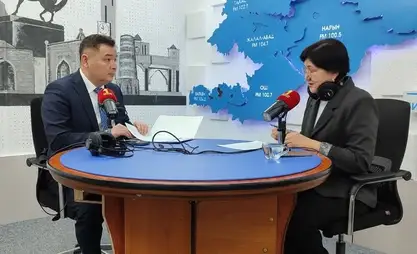
Bishkek, March 26, 2026 /Kabar/. Minister of Economy and Commerce of Kyrgyzstan, Bakyt Sydykov, spoke about the key projects and measures to support the country's economy on Birinchi Radio.
According to him, the state implements a number of major initiatives. In the energy sector, the construction of the Kambarata HPP remains a priority, while at the same time work is being carried out on the development of small and medium-sized businesses, including projects in the field of microgeneration and the launch of small energy facilities.
In the transport and logistics sphere, in addition to railway projects, the development of warehouse infrastructure is planned. As minister noted, there are no restrictions on the implementation of such initiatives, and they can be freely promoted by investors.
Sydykov emphasized that key investment projects are defined for each direction, which form the basis for further growth of the industry.
Speaking about economic indicators, the minister said that at the end of last year, the real GDP growth was 11.1%. On average, over the last four years, the country's economy has grown at the level of about 10.2% annually. In the current year, the authorities intend to maintain the set pace.
Business, especially the private sector, plays a significant role in the economy. According to preliminary data for 2025, the share of small and medium-sized businesses in GDP increased to 51% against 42% earlier.
In January, the program of financing SMEs with the amount of about 3.7 billion soms was launched as additional support. Within its framework, two state banks provide preferential loans in national currency for up to five years at a rate of about 6% per annum.
National platform for the development of small and medium-sized businesses was also created in March, uniting state bodies, banks and international organizations. It will be engaged in coordination of program support and training, coordination of decisions between departments, as well as development of common financial instruments and digital interaction.
The minister noted that work in these directions will be continued, and the main task remains the achievement of strategic goals by 2030.