
Central Asia remains a region of sustainable development, where economic growth rates significantly exceed global averages. While the global crisis caused by the escalation in the Middle East continues, a number of large countries have been hit by an energy shock, with a shortage of petroleum products leading to higher prices, a decline in production, and spurring inflation. It is important to note that the consequences of the conflict in the Persian Gulf will have a long-term impact due to accumulated logistical disruptions and empty gas and petroleum storage facilities. In the baseline scenario, global economic growth will slow to 2.5%.
In Central Asia, integrated into new supply chains within the EAEU and SCO, the global crisis has also led to higher fuel prices, but not as noticeably as in the rest of the world. This allows not only for sustainability but also for sustaining high economic activity. A new report from the Eurasian Development Bank (EDB) presents a macroeconomic forecast according to which the combined economic size of Central Asian states could exceed $600 billion by 2026.
Kyrgyzstan retained its leading position in the region with GDP growth of 10.2% this year; our closest neighbors and partners in the EAEU are showing somewhat more modest results. However, their macroeconomic stability is beyond doubt. In 2027, the EDB partner countries will continue to experience high growth rates, although perhaps not as significant as in previous years, due to structural changes in their economies and the transition to balanced development.
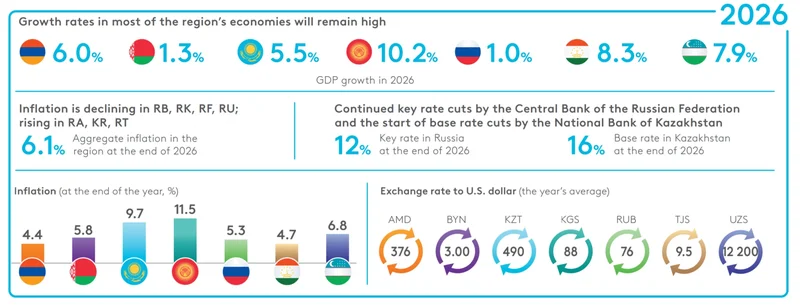
According to expert estimates, the region is entering a phase of sustainable development. This means abandoning the race to overheat and curtailing the "raw materials model" in favor of long-term macroeconomic stability. The development of industry and domestic production will protect markets from exported inflation, which is transmitted to the consumer sector. It is expected that over the coming years, as the development space stabilizes and harmonizes, inflation will decrease by approximately a third, at which point central banks will lower their key rates. This will create a less risky and more predictable environment for business development, the implementation, and launch of joint projects.
Now, regarding Kyrgyzstan, EDB analysts recorded that the republic's economy set a new record in the first four months of 2026, with GDP growth reaching 12.4%. This rapid growth is driven by strong domestic demand and investment inflows.
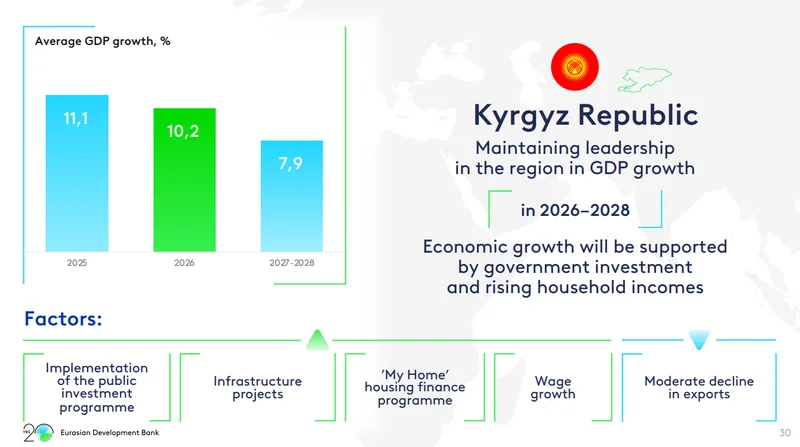
By the end of the year, the republic's gross domestic product will increase by 10.2 percent. Double-digit growth in this indicator has been maintained in our country for the past three years. However, over the next three years, economic growth rates will reach more balanced levels due to structural reforms.
Inflation, which could reach 11% and even exceed that mark, is a concern. In response, the National Bank has tightened monetary policy, raising the key rate to 12%. However, additional pressure on inflation is currently being created by increased pricing pressure in global food markets and rising global oil prices due to logistics complications amid the conflict in the Middle East. Internal factors include rising utility tariffs and strong demand, which is driving up consumer prices. According to EDB forecasts, inflation will slow to 9% next year and enter the target range, with an upper limit of 7%, by the end of 2028.
The som exchange rate will remain stable within the range of 88-89 soms over the next three years. Experts note the importance of the substantial safety margin created in Kyrgyzstan:
"The level of foreign exchange reserves, thanks to gold accumulation, has reached a historic high, covering seven months of imports. This provides additional room to smooth out sharp fluctuations in the som exchange rate. We forecast stability in the som exchange rate in 2026."
Regarding development plans, EDB analysts point to the active work to stimulate domestic growth through the public investment program: "In 2025, a record volume of sovereign financing was attracted in 12 years—$981.3 million—for the implementation of long-term infrastructure projects. For comparison, in 2014–2024, the average annual volume of funds from international financial institutions amounted to $565 million. Furthermore, the Kyrgyz-Russian Development Fund approved a record investment volume for 2026, over $200 million, to strengthen the industrial base."
The implementation of government infrastructure projects will contribute to maintaining high rates of economic growth. By 2030, the government plans to implement 200 projects in energy, tourism, industry, education, and healthcare. The state program "My Home," which provides preferential housing financing for civil servants and public sector employees, is expected to continue to support economic growth.
Overall, Kyrgyzstan's development prospects are viewed optimistically. The country has a budget surplus and sufficient reserves to mitigate external pressure while implementing domestic development programs and infrastructure projects, including those of regional significance. The economy is resilient and supported by long-term development programs.