
Bishkek, June 4, 2026. /Kabar/. The bulk of Kyrgyzstan's public debt is used to finance projects related to the development of energy, transport, and infrastructure. Economists note that the country has sufficient capacity to service the public debt; however, since the loans received are long-term, they will be repaid strictly on time. They also predict that Kyrgyzstan's external debt will be fully repaid by 2035.
Currently, Kyrgyzstan's public debt to gross domestic product (GDP) ratio is 41%. Abdanbek Abdybapov, head of public debt department of finance ministry told Kabar.
According to him, the state of public debt can confidently be considered stable. According to the public debt management strategy, the established threshold indicator relative to GDP is 70%. If the indicator approaches 70%, it means the state is experiencing certain problems with debt repayment. In Kyrgyzstan, this indicator is at 41%.
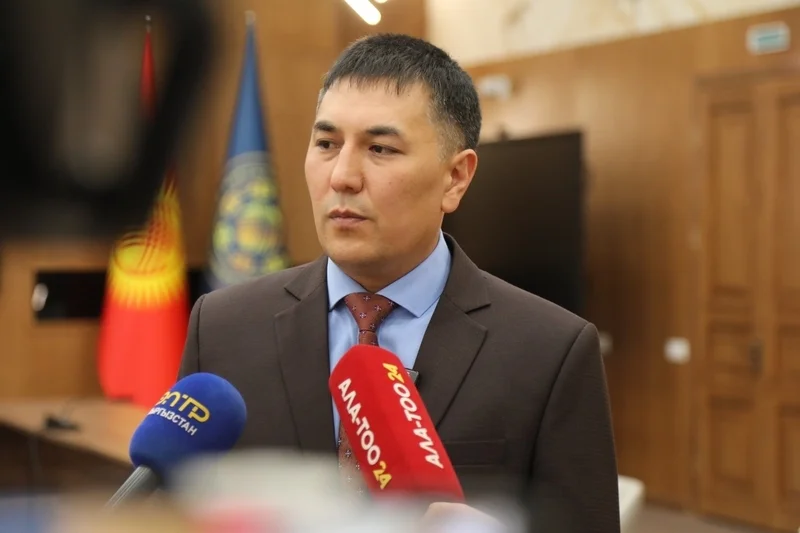
Abdanbek Abdybapov also noted the existence of indicator according to which public debt servicing costs should not exceed 30% of the national budget revenue. At the end of 2025, this indicator in Kyrgyzstan was 12.6%, which is a very low and favorable value. This means that the country will not face difficulties servicing its public debt. Regarding the public management strategy, there are no overdue debts. There is a special provision called "mandatory payments" provided for servicing the public debt.
As economist Kuban Choroev recalls, in 2020, the public debt-to-GDP ratio reached 68%. That was signal that country could no longer borrow. By the end of 2025, although the debt had reached $8.92 billion, its ratio to GDP had fallen to 41%. Compared to 2020, this figure has decreased almost by half. Thanks to rapid growth, the economy has almost tripled in size, reducing the debt burden in real terms.

Kyrgyzstan currently has sufficient reserves to repay its external debts, economist Iskender Sharsheev expressed his view.

"Early repayment of funds also creates problems and will require additional costs, . We have accumulated approximately $9 billion in internal reserves. These reserves will be used to service our external debt. If the debt is $9 billion, then early repayment will require paying twice as much as $18 billion. Now, with the onset of the payment period for previous debts, our country has begun to pay $400-500 million annually," the economist noted.
Following Kyrgyzstan's external debt, Iskender Sharsheev spoke about external debt figures of the EAEU and CIS countries.
"For example, Kazakhstan's debt has exceeded $182 billion. Uzbekistan's debt is approaching $46 billion. Armenia's external debt has reached $13 billion, and Belarus's $37 billion," he concluded.