Statistics provide a foundation of objective data and expert calculations, and it is often said that numbers do not lie. However, numbers can be manipulated, particularly for political purposes, to confuse the public, mislead citizens, and erode institutional trust. For this reason, as Kyrgyzstan prepares for a series of high-profile events, including the SCO Summit, official visits from world leaders to Bishkek, the World Nomad Games, and Independence Day celebrations, it is absolutely critical for the public to remain vigilant, critically evaluate statistics, and carefully verify the information being disseminated.
Furthermore, with the official processes surrounding the next presidential election commencing this autumn, Kyrgyzstan is entering a period of profound domestic and international political importance. As is common during major political cycles, public discourse has seen an influx of unverified commentary. Current debates frequently target the nation's external debt, framing it as an existential threat to economic stability, territorial integrity, and sovereignty. It is worth noting, however, that these speculative claims contradict objective macroeconomic data and the actual financial state of the country.
Kyrgyz President Sadyr Zhaparov has commented on external debt several times. He has given exhaustive explanations regarding the status of payments on previous obligations, that country is capable of repaying all borrowings, and that the debt-to-GDP ratio is not increasing, on the contrary, decreasing. In every media interview, the head of state calmly and persistently explains the situation, relying on objective data and figures. In his latest speech, he once again commented on the situation for those who are not getting it or are having trouble digesting the information.
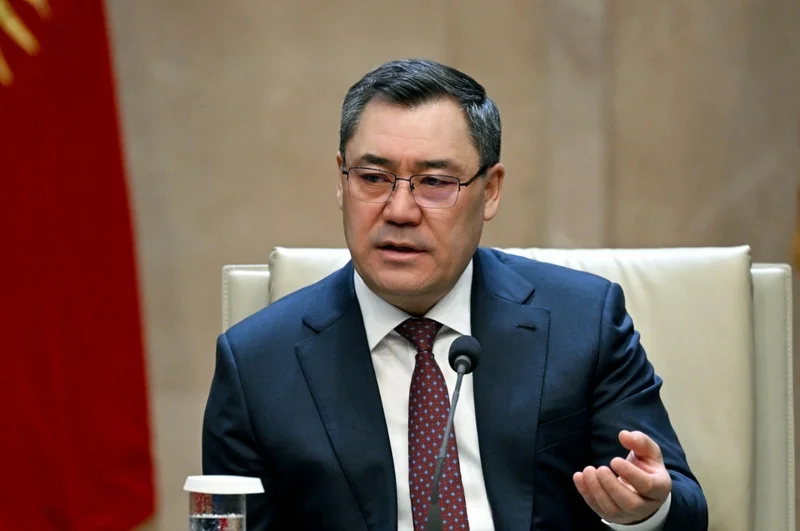
"When I took office in 2020, Kyrgyzstan's total public debt was about $5 billion. This is domestic and external debt combined. Relative to GDP, it was about 70%.
The external debt amounted $4.217 billion from $5 billion, domestic debt was $708 million. In 2026, total debt has risen to $10 billion. But relative to GDP, it has fallen to 37%, as GDP has grown. GDP is currently about $22.5 billion. Previously, debt was 70% of GDP, but now it's about 37%. Therefore, we can't simply say that the debt has grown from $5 billion to $10 billion.
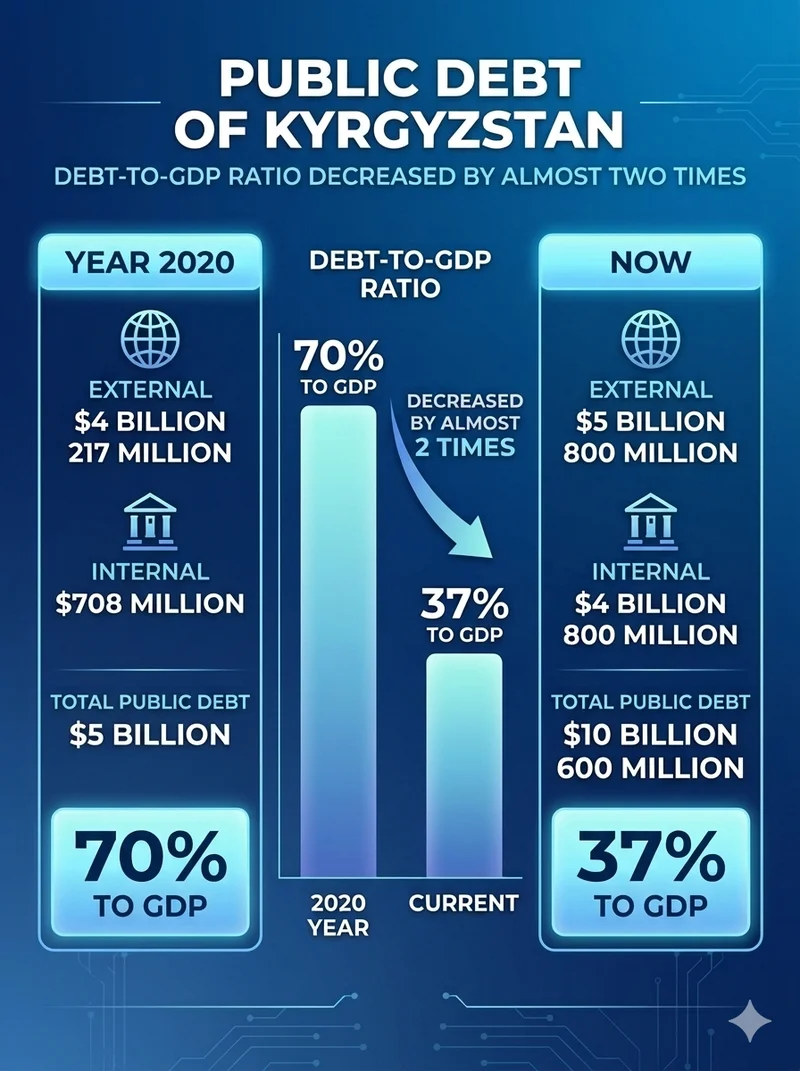
Currently, the external debt is $5.8 billion, and the domestic debt is $4.8 billion. The external debt has indeed grown by approximately $1 billion. Kyrgyzstan did not borrow this billion from China. Kyrgyz government raise funds from donor organizations like EBRD, ADB and international financial institutions. Over the past five years, Kyrgyzstan haven't borrowed a single cent of external debt from China. On the contrary, the country repaid approximately $500 million.
When I took office in 2020, the debt to the China Exim Bank was approximately $1.8 billion. Over the past five years, it was reduced to approximately $1.3 billion. Kyrgyzstan to fully repay this debt by 2035. As for current external loans, government using them for targeted purposes: for factories, plants, roads, the Kambarata HPP, and other projects.
Take the Kambarata-1 HPP as an example: it is expected to clear its construction costs in about 13 to 15 years. After that, the station will cover its own expenses through its own activities, meaning the project will not rely on the national budget for repayments.
The construction of China-Kyrgyzstan-Uzbekistan railway provided not from public debt at all. It's a commercial project. Each participant invests their own funds and then, over a certain period, recoups their investment through the project.
There are other projects, too. For example, a waste recycling plant in Bishkek. The government provide the land, the plant operates for 15-20 years, funds itself, and then remains in Kyrgyzstan. It will operate and generate income for us, and 100% will belong to the state.
Kyrgyzstan will fully repay external debt to China by 2035. The remaining funds will be used for plants, factories, and infrastructure projects. About 15-20% could be used for roads," explained Sadyr Zhaparov.
With certain allowances and assumptions, the situation with Kyrgyzstan's public debt has changed approximately as follows over the past five years: the country's budget has grown to a record $30 billion, and this is the main factor in our financial solvency and stability. In other words, the economic situation has improved significantly, and the volume of external liabilities no longer poses a threat to the budget, social sphere, or the country's development.
However, the situation requires further analysis by experts. Kabar reached out who worked with economic calculations and figures professionally.
Former head of Cabinet of Ministers Akylbek Zhaparov, in his interview with Kabar provided a broader retrospective of how the country's solvency and the state of the economy have changed.
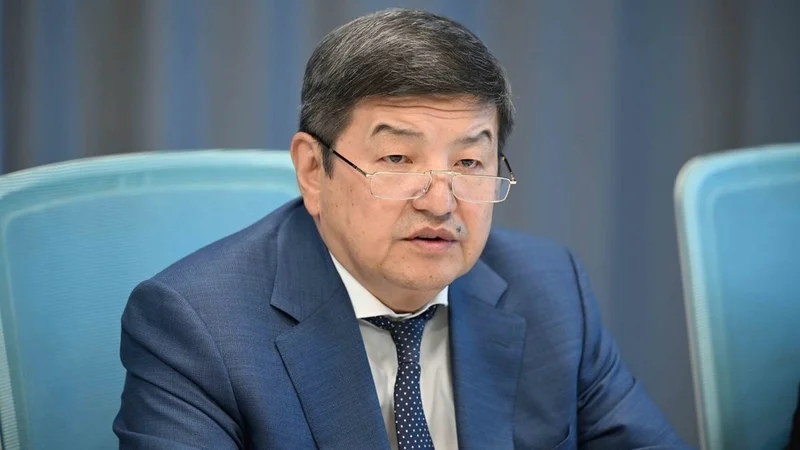
"In 2005, the national debt was at $2 billion, and the GDP was at the same level. That is, the country was 100% on the verge of bankruptcy. In 2020, the debt reached 70% of GDP. Today, the national debt is only 37%. Therefore, those unfamiliar with the budget or the economy draw conclusions based on hearsay, often get confused by the figures, and misinterpret the debt situation.
Kyrgyzstan is currently at a safe level. This is confirmed by data from international rating agencies, among others. The National Bank of Kyrgyzstan's gold and foreign exchange reserves currently stand at approximately $10 billion, and the government itself also has reserves. Therefore, citizens should have no concerns about the national debt.
For information, since 2020, the government reduced the external debt. As for domestic debt, this money is being used to develop our economy. These loans are serviced within the country and benefit for the country. The government can clearly demonstrate where this money has been spent, and which projects. These investments are being used for effective and self-sustaining programs that become the foundations of long-term sustainable growth.
As for external debt, the peak period for repayments is 2024–2030. These are repayments on external obligations incurred before 2020. We currently repay approximately $500 million annually, and Kyrgyz economy allows confidently handle this burden.
I want to point out that the borrowings made previously, before, were ineffective, and yet, Kyrgyzstan is now holding on very confidently," states Akylbek Zhaparov.
Honored Economist of Kyrgyzstan Nurbek Elebaev also commented on the country's public debt to Kabar.

“I consider it important to first and foremost say that in recent years, the country has been pursuing a policy of borrowing and channeling state-backed funds toward creating new value and investing in the development of a renewed economy. This is not bad; on the contrary, it is good not only for citizens but also for the country's economy as a whole.
By increasing public debt, the state is directing direct investment into areas that produce sustainable economic and social benefits. At the same time, investments are being channeled into infrastructure and projects with sustainable, long-term potential. Moreover, budget revenues are growing, increasing the country's solvency. Public debt management is improving, business activity is increasing, exports are growing, and the economy's sensitivity to external shocks is decreasing. Therefore, every piece of criticism against the government is completely baseless.
The situation with the growing public debt for the country today has the following objective realities. The republic has finally begun to implement sustainable and progressive economic development on a large-scale basis.
The results are clear: year after year, the country has been one of the leaders in annual economic growth and rising living standards. At the same time, the country is not just spending public debt, as it did before, but is directing it towards increasing investment and increasing business activity, reducing its sensitivity and exposure to external shocks, as well as supporting the growth of domestic debt through the development of the government bond market in the country, attracting funds that are directed towards the implementation of investment projects, as well as reducing currency risks, to finance the economy and solve all the global problems that have befallen to the country.